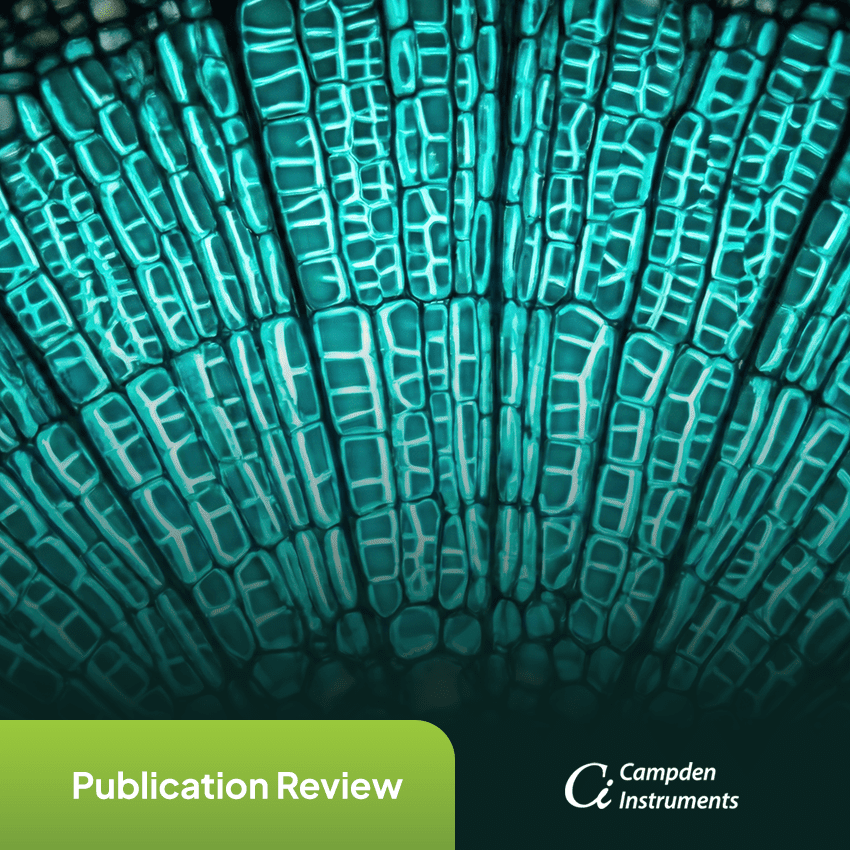
At its core, Earth Day, on April 22nd, is about raising awareness and encouraging individuals, communities, and governments to take steps toward protecting ecosystems, addressing climate change, and promoting sustainability. Along those lines, it presents a reminder to stop and think about how the health of the planet is rooted in the biology of plants. From nitrogen-fixing symbioses that enrich soils to the formation of woody biomass that stores carbon, plant systems play a crucial role in sustaining ecosystems. Understanding the cellular and molecular mechanisms behind these processes is key to developing more resilient crops and improving carbon capture. The following publication review highlights two recent preprint studies utilizing Campden vibrating microtomes to slice plants to uncover how they regulate symbiosis and wood formation at the microscopic level. Featured image (Tinttrex/stock.adobe.com) displays a view of plant root vascular tissue.
Aeschynomene americana induces terminal bacteroid differentiation in Bradyrhizobium sp. USDA3516, a novel model for Dalbergioid-rhizobia symbiosis
Legumes form mutualistic relationships with nitrogen-fixing rhizobia, a process that is essential for soil fertility and sustainable agriculture. However, most knowledge of these interactions comes from a limited group of model legumes, leaving gaps in our understanding of symbiosis in more evolutionarily distinct lineages. Carlew et al. (2025) investigated the Dalbergioid legume Aeschynomene americana, a promising genetic model, to better understand its compatibility with different rhizobial strains and the mechanisms underlying bacteroid differentiation.
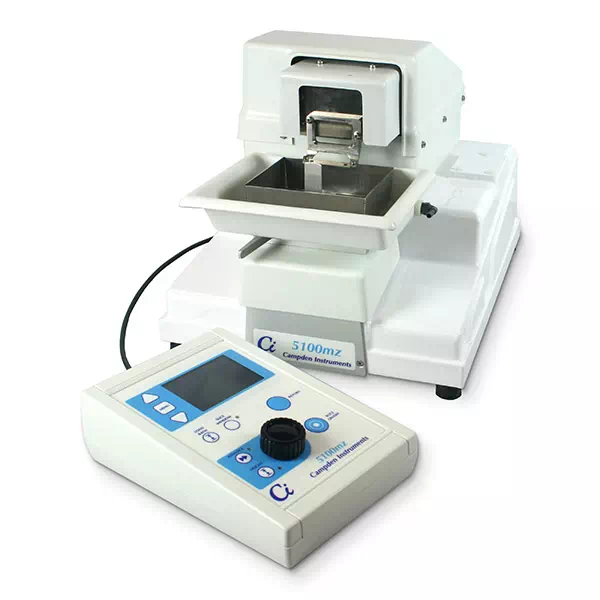
The researchers inoculated A. americana plants with a panel of rhizobial strains and assessed nodulation, nitrogen fixation, and plant growth responses. Nodule structure and bacteroid morphology were examined using fluorescence staining, confocal microscopy, and flow cytometry. To prepare nodule cross-sections for imaging, 100 µm slices were produced using a Campden Instruments 7000smz-2 Vibrating Microtome, enabling consistent, high-quality tissue sections for detailed structural analysis.
Four rhizobial strains formed highly effective symbioses with A. americana, producing numerous nodules and strong nitrogenase activity, while others were ineffective or non-nodulating. Confocal imaging of nodule slices revealed diverse bacteroid morphologies, with the native strain Bradyrhizobium sp. USDA3516 forming large, branched bacteroids with increased ploidy. Interestingly, branching was not strictly correlated with symbiotic efficiency, suggesting that endoreduplication rather than morphology may be the key determinant of effective nitrogen fixation. These findings challenge prevailing assumptions about bacteroid structure and provide a new model for studying legume-rhizobia symbiosis.
Novel repressors of cambium activity in Arabidopsis
Wood serves as one of the largest reservoirs of terrestrial biomass and a vital carbon sink, formed by the stem cell population known as the vascular cambium, which is a specialized meristem that fuels stem growth in seed plants. While many factors that promote cambium activity are known, relatively few repressors have been identified. Wang et al. (2026) sought to uncover new molecular regulators that balance cell division and differentiation within the cambium of Arabidopsis, helping to control wood formation and plant growth.
The team combined transcriptomic analysis, transcriptional network mapping, reporter gene assays, and mutant studies to identify regulators of cambium activity. Confocal imaging was performed on fresh material which had been embedded in 4% agarose prior to sectioning on a Campden Instruments 7000smz-2 Vibrating Microtome RNA-seq of mutant lines was used to pinpoint candidate genes, followed by yeast one-hybrid assays and chromatin immunoprecipitation to confirm transcription factor binding. Functional analyses in overexpression and loss-of-function lines allowed the researchers to determine how these factors influenced vascular development and cambium activity.
The study identified three transcription factors that repressed cambium activity: ATHB23, ATHB30, and ATHB34. These directly reduced the expression of genes that promote vascular cell division. Together, the results reveal a regulatory mechanism that balances proliferation and differentiation in the cambium, shaping wood formation and biomass accumulation.
Conclusions
These studies by Carlew et al. (2025) and Wang et al. (2026) highlight how plant systems ranging from nitrogen-fixing root nodules to wood-forming cambium drive soil health, carbon storage, and ecosystem sustainability. Together, they underscore the importance of precise cellular studies and the tools that enable them as we work toward a more sustainable future.

Upcoming Events
-
39th ENCP Congress
Date: October 10-13, 2026 -
AALAS National Meeting 2026
Date: October 25-29, 2026 -
Society for Neuroscience 2026
Date: November 14-18, 2026