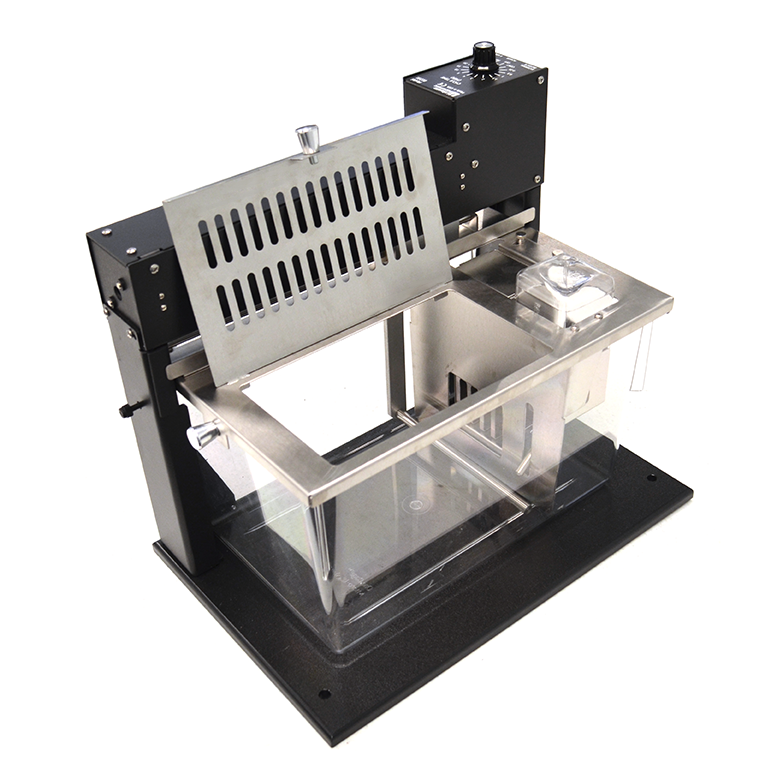
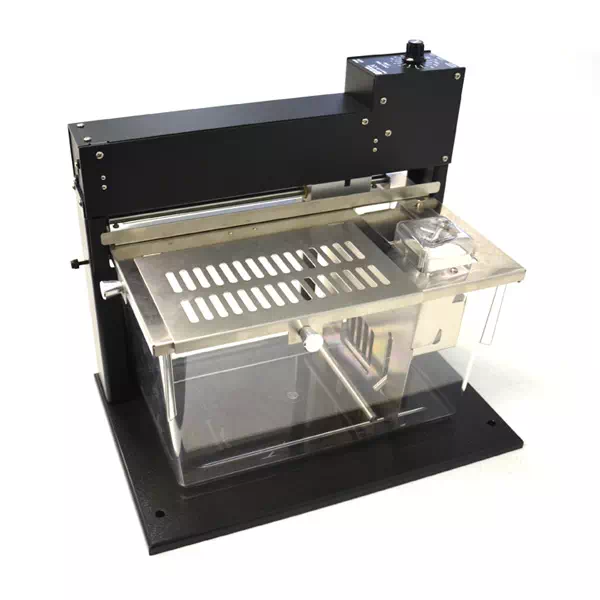
The Lafayette Instrument Model 80391 Sleep Fragmentation Chamber uses a motorized sweep bar that travels back and forth across the living space, gently preventing rodents from entering sustained sleep. The chamber supports both mice and rats, but the two species require meaningfully different mechanical settings, a detail that the manual treats briefly but that demands careful attention in practice.
Two independent mechanical parameters govern the sweep arm’s behavior: cycle time (how often a sweep occurs) and force (how hard the arm will push until a safety clutch slips). A third adjustment, sweep arm height, is species-specific and affects whether the arm effectively contacts the animal at all.
The sweep arm is the heartbeat of your sleep fragmentation experiment. Issues in force and timing could risk either injuring your animals or failing to disrupt sleep at all. This guide walks through both adjustments from first principles.
Understanding Cycle Time
Cycle time is defined as the interval from the start of one sweep to the start of the next, not the gap between sweeps. This distinction matters when calculating actual disturbance frequency.
| Mode | Cycle Time | Typical Use |
| CONT (Continuous) | ~7.5 sec/sweep | Maximum fragmentation; acute deprivation studies |
| 0.25 min | 15 seconds | Severe fragmentation protocol |
| 0.5 min | 30 seconds | Aggressive fragmentation |
| 1 min | 60 seconds | Moderate fragmentation (common baseline) |
| 2 min | 2 minutes | Mild fragmentation |
| 5 min | 5 minutes | Minimal protocol / control comparison |
| 10–30 min | 10, 15, 20, 25, 30 min | Long-interval disturbance |
What a “sweep” actually does
A single sweep is a three-phase motion: the arm first nudges toward the nearest wall, then traverses the full chamber width to the opposite wall, then retreats slightly. The complete motion takes approximately 7.5 seconds. In continuous mode, each new sweep begins immediately after the last, with only a brief natural pause at each end considered normal.
NOTE: Always turn the unit OFF before changing cycle time. Adjusting the selector while powered will cause an unpredictable first sweep interval. After the first complete cycle following power-on, timing reliably follows the selected value.
Safely changing cycle time
- Press the power button to turn the unit OFF. The green LED will extinguish.
- Rotate the cycle time selector to the desired setting.
- Press the power button to turn the unit ON. The arm will home toward the food/water wall, then begin its first sweep.
- Discard the timing of the first cycle; verify interval consistency on the second and subsequent sweeps.
Sweep Arm Force Adjustment
The sweep arm uses a slip-clutch mechanism: when the arm meets resistance exceeding a set threshold, the drive slips rather than forcing through, protecting the animal. The factory default is calibrated at approximately 500 grams of resisting force; appropriate for mice, but often insufficient to reliably disturb rats.
NOTE: Small adjustments in the tension screws result in large changes in sweep arm force. Never tighten beyond finger tight.
Species Recommendations
| Species | Default Force | Adjustment Needed |
| Mouse | ~500 g (factory) | None typically required |
| Rat | ~500 g (factory) | Increase; rats require higher force to be disturbed reliably |
Locating the tension screws
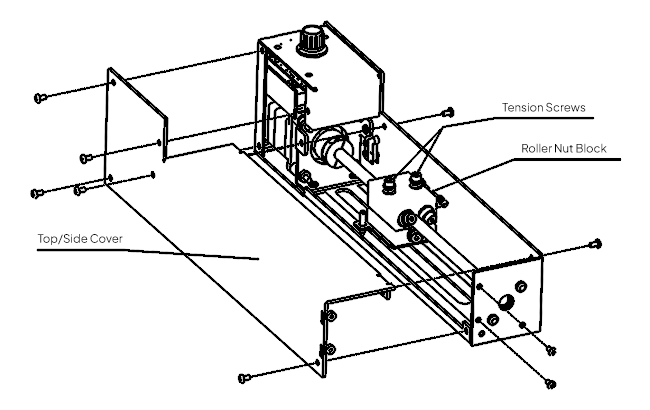
The two tension screws sit on top of the roller nut block, accessed only after removing the Top/Side cover from the drive assembly. The cover is secured by 5 screws on the left side, 2 on the end, and 2 on the right side. The chamber does not need to be removed during this procedure.
Step-by-step force adjustment
- Baseline test: Run the unit in continuous mode. Press your hand against the sweep arm with increasing pressure until the drive slips. Note the approximate force and test in both travel directions. Force may differ.
- Remove cover: Take out the 9 screws (5 left, 2 end, 2 right) and lift off the Top/Side cover. The chamber and sweep arm can remain in place.
- Loosen to baseline: Turn both tension screws counter-clockwise until very loose. Do not remove them. Run in continuous mode to confirm the arm barely moves — this confirms you are at minimum clutch force.
- Increment up: Stop the unit. Finger-tighten both screws equally by ½ turn clockwise. Run and apply opposing hand pressure to test. Stop the unit.
- Repeat in ½-turn increments until the desired slip force is reached. Tighten both screws equally at each step to maintain symmetrical drive pressure.:
- Reduce if needed: If force overshoots, loosen both screws equally by ½ turn and retest.
- Replace cover and run a final confirmation test before returning animals to the chamber.
NOTE: Do NOT tighten the tension screws beyond finger tight. Excessive force will exceed the drive motor’s capability, indicated by severe vibration and a buzzing sound. If you observe this, immediately loosen both screws and power OFF.
Sweep Arm Height Adjustment
The sweep bar ships with it set at ½ inch above the bare floor and optimized for mice. For rats, this height is insufficient for reliable contact. The product manual recommends raising the bar to approximately ¾ inch above the floor for rat studies.
Raising the sweep arm for rats
- Power OFF the unit and loosen the 2 screws securing the sweep-arm leg to the drive block.
- Raise the leg approximately ¼ inch to reach the ¾ inch floor clearance target.
- Retighten the screws firmly.
- Run in continuous mode and verify that the top of the sweep-arm leg does not contact the underside of the drive assembly at any point during the full sweep travel.
NOTE: Height and force adjustments are independent: raising the arm height does not change clutch slip force. For rats, you should typically both raise the arm and increase the force setting.
External Trigger and Event Output
For automated protocols synchronized with EEG or other acquisition hardware, the 80391 provides a 2.5 mm 3-conductor jack that serves dual roles. A momentary 20 ms active-low pulse on the tip initiates a single sweep externally. The ring outputs a 50 ms active-low event mark at the start of each sweep, which is useful for timestamping in polysomnography software. Both share a common base ground. Contact Lafayette Instrument for appropriate mating hardware.
Quick Reference
| Parameter | Mice | Rats |
| Sweep arm height | ½ in (factory default) | ¾ in (raise ¼ in) |
| Clutch slip force | ~500 g (factory default) | Increase via tension screws |
| Cycle time range | Continuous (~7.5 s) through 30 min | Continuous (~7.5 s) through 30 min |
| Power supply | 9 VDC @ 2A, center positive (included) | 9 VDC @ 2A, center positive (included) |
| Ext. initiate pulse | 20 ms active low (tip conductor) | 20 ms active low (tip conductor) |
| Event mark output | 50 ms active low (ring conductor) | 50 ms active low (ring conductor) |
Upcoming Events
-
AALAS National Meeting 2026
Date: October 25-29, 2026 -
Society for Neuroscience 2026
Date: November 14-18, 2026 -
American Society for Gravitational and Space Research (ASGSR) 2026
Date: December 2-5, 2026