Metabolic diseases, including obesity and type 2 diabetes, are associated with a range of health complications that contribute to increased morbidity and mortality. Due to the complexity of these conditions, understanding their underlying mechanisms is essential to developing effective therapeutic strategies. This publication review highlights two recent studies that utilized ALZET® Osmotic Pumps to provide continuous, controlled compound delivery to investigate obesity, type 2 diabetes, and cardiovascular health. These findings demonstrate how ALZET Pumps support preclinical research by enabling researchers to evaluate potential therapeutic strategies and better understand the physiological effects of emerging metabolic treatments.
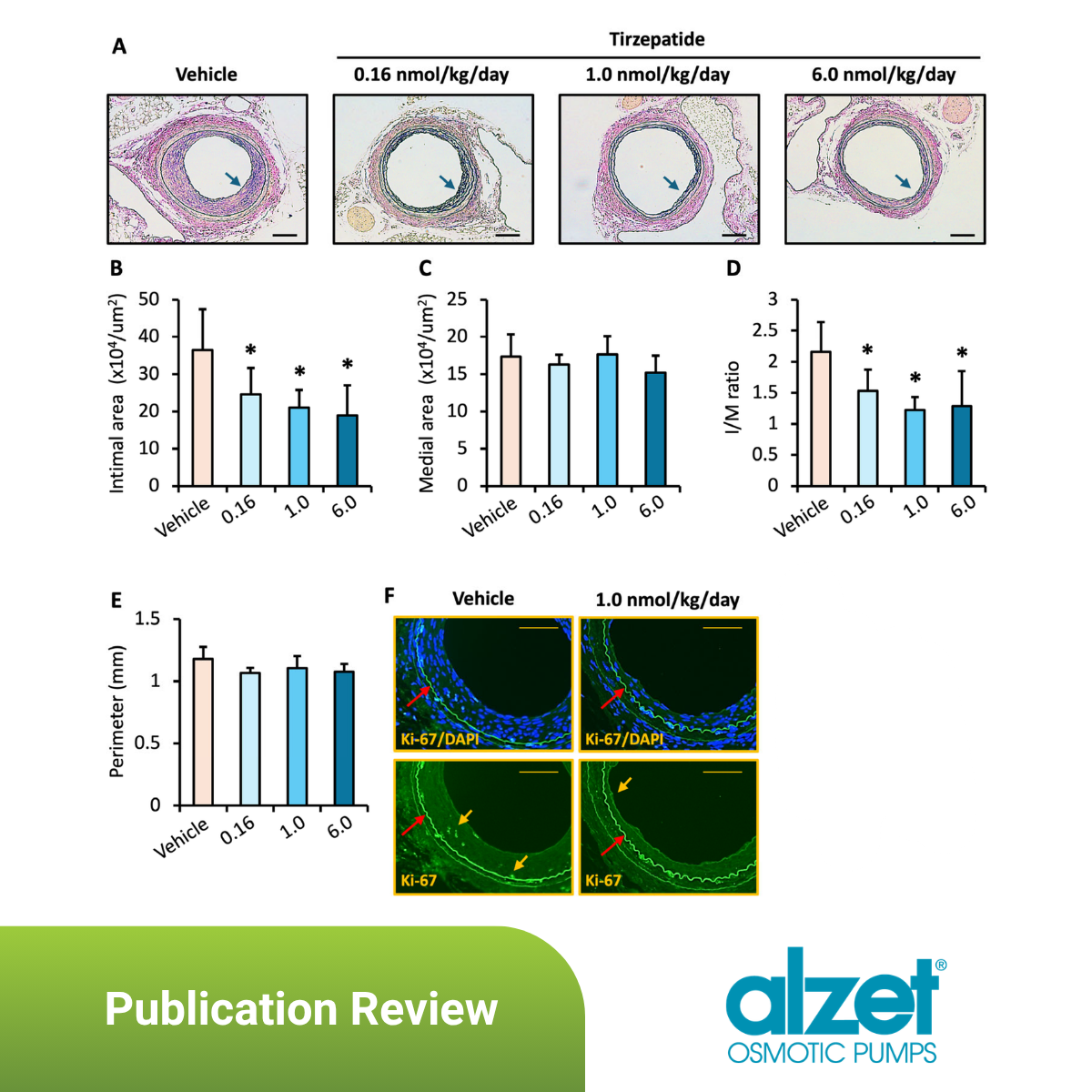
Note: Featured image from Mori et al. (2026) (licensed under CC BY 4.0) reveals the effects of administering different doses of tirzepatide using subcutaneously implanted ALZET Osmotic Pumps on arterial remodeling in non-diabetic mice. A) Images of EVG-stained femoral arteries. Arrows indicate the intima. Scale bar = 100 μm. B) Intimal area. C) Medial area. D) Intima/media (I/M) ratio. E) Arterial perimeter. (B–E) Vehicle, n = 14; tirzepatide 0.16 nmol/kg/day, n = 8; tirzepatide 1.0 nmol/kg/day, n = 7; tirzepatide 6.0 nmol/kg/day, n = 7. F) Femoral arteries immunostained for Ki-67 (green); nuclei counterstained with DAPI (blue). Yellow arrows indicate Ki-67-positive cells; red arrows indicate the internal elastic lamina. Scale bar = 100 μm.
Investigating Mitochondrial Genetics in Type 2 Diabetes
Obesity is a well-established risk factor for the development and progression of type 2 diabetes, and researchers continue to investigate the underlying mechanisms of these conditions while developing new therapeutic strategies. In a new publication from Ivyspring, Yen et al. (2026) identify a previously unrecognized contributor to metabolic dysfunction. The group highlights racial and ethnic differences in type 2 diabetes (T2D) prevalence and outcomes, focusing on the Mexican-American population because they are “more than twice as likely to be diagnosed with T2D under the age of 40 compared to non-Hispanic Whites.” They hypothesized that mitochondrial genetics play a role in T2D within this population. Unlike nuclear DNA, mitochondrial DNA is maternally inherited and does not undergo recombination, making it highly conserved within populations.
Study Design and Experimental Methods
The researchers employed various methods to investigate their hypothesis:
- Mitochondrial genome-wide interaction study conducted in selected cohorts, genotyping, and data analysis
- Isolation and creation of a custom antibody for mass spectrometry and MTT assay to determine biological functions
- Mouse studies including:
a. Pharmacokinetic study
b. Short-term treatment with normal chow or high-fat diet followed by glucose tolerance testing
c. Long-term high-fat diet study with insulin tolerance testing
d. Diet-induced obesity and ob/ob mouse studies with metabolic cage and metabolomic analyses
e. ALZET Osmotic Pump Studies
Key Findings: MENTSH and Metabolic Regulation
The researchers were able to isolate a single nucleotide polymorphism (SNP) and mitochondrial-derived microprotein (MDP) associated with type 2 diabetes. They named this SNP MENTSH (MDP Encoded in the ND-Two Subunit of Humans), and it was found to be prevalent in populations indigenous to America. When administered to mice via IP injections, MENTSH was shown to improve insulin signaling. As an alternative route of administration, ALZET Pumps were subcutaneously implanted in 14-week-old C57BL6/J mice. The pumps were filled with PBS, MENTSH (5 mg/kg/day), or MENTSH analogue M32PH (2.5 mg/kg/day). As observed with IP administration, continuous infusion of MENTSH also reduced weight gain. M32PH and other MENTSH analogues likewise blocked high-fat diet-induced weight gain.
Overall, the researchers demonstrated that MENTSH is a promising therapeutic target for regulating metabolism and may help identify individuals at increased risk for diabetes. Using ALZET Osmotic Pumps, they were able to evaluate the long-term therapeutic potential of MENTSH and its analogues, demonstrating improved insulin signaling and reduced weight gain.
Exploring the Cardiovascular Effects of Metabolic Treatments
In a different metabolic study published by MDPI, Mori et al. (2026) investigated the interplay between obesity, diabetes, and the cardiovascular system. Obesity is a major risk factor for type 2 diabetes, which in turn increases the risk of developing atherosclerotic cardiovascular disease. Because of their glucose-lowering, weight loss, and cardiovascular benefits, GLP-1 receptor agonists have become an important class of therapeutics for treating T2D. Mori et al. (2026) also note that recent clinical trials have shown that the dual GIPR/GLP-1R agonist tirzepatide provides significant reductions in glucose and body weight while offering cardiovascular benefits. In their publication, the researchers investigated whether tirzepatide suppresses arterial remodeling and whether its vasoprotective effects differ from those of semaglutide at an equivalent dose.
Study Design and ALZET Osmotic Pump Administration
Ten-week-old male C57BL/6 non-diabetic mice and KK-Ay diabetic mice were used. Mice were divided into four experiments and received continuous subcutaneous infusion of tirzepatide or semaglutide using implanted ALZET Model 1004 Pumps.
L-NAME was administered through drinking water to reduce plasma nitric oxide and aortic endothelial nitric oxide synthase phosphorylation in mice.
Experiment 1: Non-diabetic mice treated with vehicle or tirzepatide (0.16, 1.0, or 6.0 nmol/kg/day)
Experiment 2: Non-diabetic mice treated with L-NAME alone or L-NAME plus tirzepatide (1.0 nmol/kg/day)
Experiment 3: Non-diabetic mice treated with vehicle, semaglutide (1.0 nmol/kg/day), or tirzepatide (1.0 nmol/kg/day)
Experiment 4: Diabetic mice treated with vehicle, semaglutide (1.0 nmol/kg/day), or tirzepatide (1.0 nmol/kg/day)
Key Findings: Cardiovascular Effects of Tirzepatide
The researchers demonstrated that tirzepatide suppressed wire injury-induced arterial remodeling through a nitric oxide-dependent mechanism, partly independent of glucose reduction. In the dose-response experiment (Experiment 1), the lowest dose of tirzepatide suppressed arterial remodeling without affecting plasma glucose levels. These findings suggest that tirzepatide may provide vasoprotective effects at doses lower than those required to lower glucose levels. Notably, tirzepatide, but not semaglutide, provided vasoprotective effects in non-diabetic mice. Tirzepatide and semaglutide produced comparable effects in diabetic mice.
Why is all this important? Although GLP-1 receptor agonists and related compounds such as tirzepatide are already approved for clinical use, preclinical research continues to uncover new therapeutic mechanisms and applications. As demonstrated by Mori et al. (2026), ALZET Pumps enable long-term evaluation of therapeutic efficacy while helping researchers investigate the physiological effects of emerging metabolic treatments.
Conclusion
Together, these studies highlight the breadth of metabolic disease research supported by ALZET Osmotic Pumps. Researchers continue to use ALZET Pumps to investigate metabolic diseases from multiple perspectives. Continuous infusion enables long-term delivery of compounds that modulate specific signaling pathways, allowing investigators to better understand the mechanisms underlying metabolic dysfunction. The same technology is equally valuable for evaluating therapeutic agents and determining how potential treatments influence disease progression, metabolism, and tissue function. Together, these capabilities allow researchers to examine disease progression, characterize underlying mechanisms, and assess the effects of new treatments, making ALZET Pumps a versatile tool for advancing both the understanding and treatment of metabolic diseases.
Advance Your Metabolic Disease Research with ALZET Pumps

ALZET Pumps have been used in thousands of diabetes and obesity publications to successfully deliver agents, such as peptide/steroid hormones, enzyme inhibitors, and GLP-1 receptor agonists.
Visit the ALZET website and read our fact sheet on metabolic diseases to determine which pumps would best suit your research!
Upcoming Events
-
AALAS National Meeting 2026
Date: October 25-29, 2026 -
Society for Neuroscience 2026
Date: November 14-18, 2026 -
American Society for Gravitational and Space Research (ASGSR) 2026
Date: December 2-5, 2026